
AIdeaBlocks Platform
AIdeaBlocks is a governed data preparation and execution platform that helps organizations transform raw enterprise data into trusted, AI-ready information. It enables users to combine data from CRM, ERP, spreadsheets, cloud data warehouses, and other enterprise systems, prepare and standardize that data, and build deterministic workflows that execute consistently every time.
Workflows can be designed and executed directly within AIdeaBlocks or invoked from Claude, ChatGPT, Microsoft Copilot, and other enterprise AI tools through our MCP (Model Context Protocol) interface. Rather than asking an AI assistant to regenerate preparation logic with every conversation, AIdeaBlocks captures reusable data preparation recipes and executes them deterministically, improving repeatability while reducing prompt complexity, token consumption, and operational costs.
AIdeaBlocks supports both ETL and ELT patterns, allowing organizations to transform data before loading it or leverage the processing power of modern cloud platforms such as Snowflake, Google BigQuery, Databricks, and other data lakes. Prepared data can be published to downstream systems, integrated with existing BI platforms, or used to power dashboards, alerts, and operational workflows.
What makes AIdeaBlocks different is its ability to combine data preparation with enterprise knowledge. Business policies, quality rules, schema definitions, business terms, matching standards, and operational logic are captured within an enterprise knowledge graph and applied automatically during workflow execution. This ensures that AI operates with the right business context, allowing organizations to build reliable, repeatable, and governed AI-driven operational processes.
How it works
From Raw Data to Trusted Results
Your CRM, ERP, spreadsheets, and partner data — cleaned, joined, and governed once, then reused by Claude and every AI tool you run. Same logic, same answer, every time, with fewer prompts and significantly lower token usage.
RevOps data
AIdeaBlocks MCP layer
Remember Revenue Rules
Definitions, policies & playbooks
Prepare Trusted Data
Clean, join & validate before Claude
Enforce Business Logic
Same policies, every run
Expose Through MCP
Claude calls governed services
Reduce Prompt Rework
Less upload, fewer tokens
Claude-ready answers
Revenue Leakage Alert
$5,526 below floor · 5 of 12 accounts
Revenue Analysis
Consistent answer in Claude
Clean CRM Data
Prepared before analysis
Lead Scores
Same logic across all reps
Pipeline Summary
Governed trail included
Agentic Data Orchestration
Use various external triggers to drive orchestration such as a prompt entered in a chat window to a lead file appearing in a drive or schedule based events. Run processes that are repeatable and can leverage AI as needed to handle exceptions and send alerts. Excute from Claude and other AI tools for more flexibility.
See it in action
Four ways AIdeaBlocks automates certainty
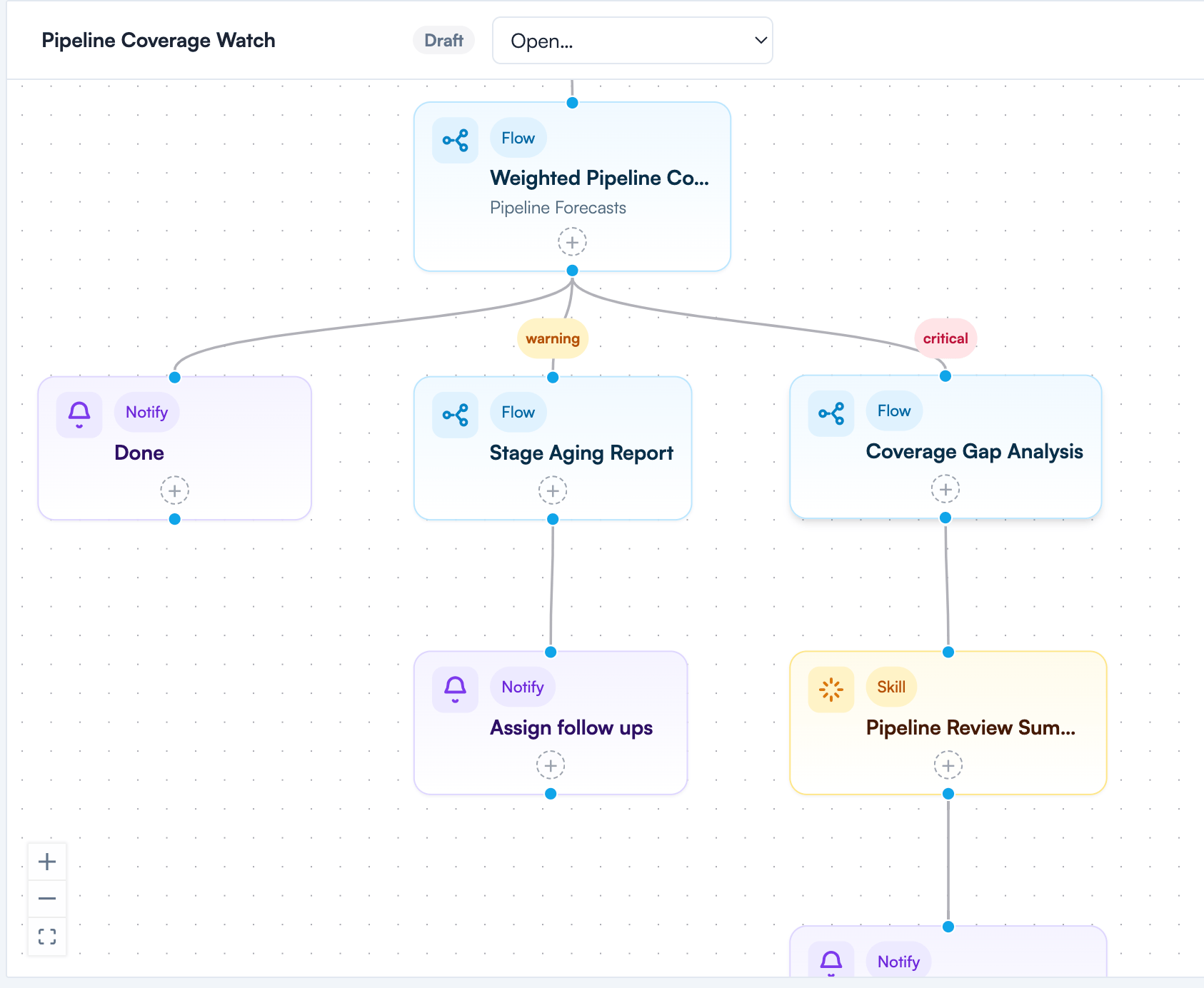
Set the process once — pull the weighted pipeline, branch on warning or critical thresholds, route each exception to the right skill or agent. When something unanticipated shows up, the process doesn’t stall or wait for a human to notice; it hands off and keeps moving, the same way, every run.
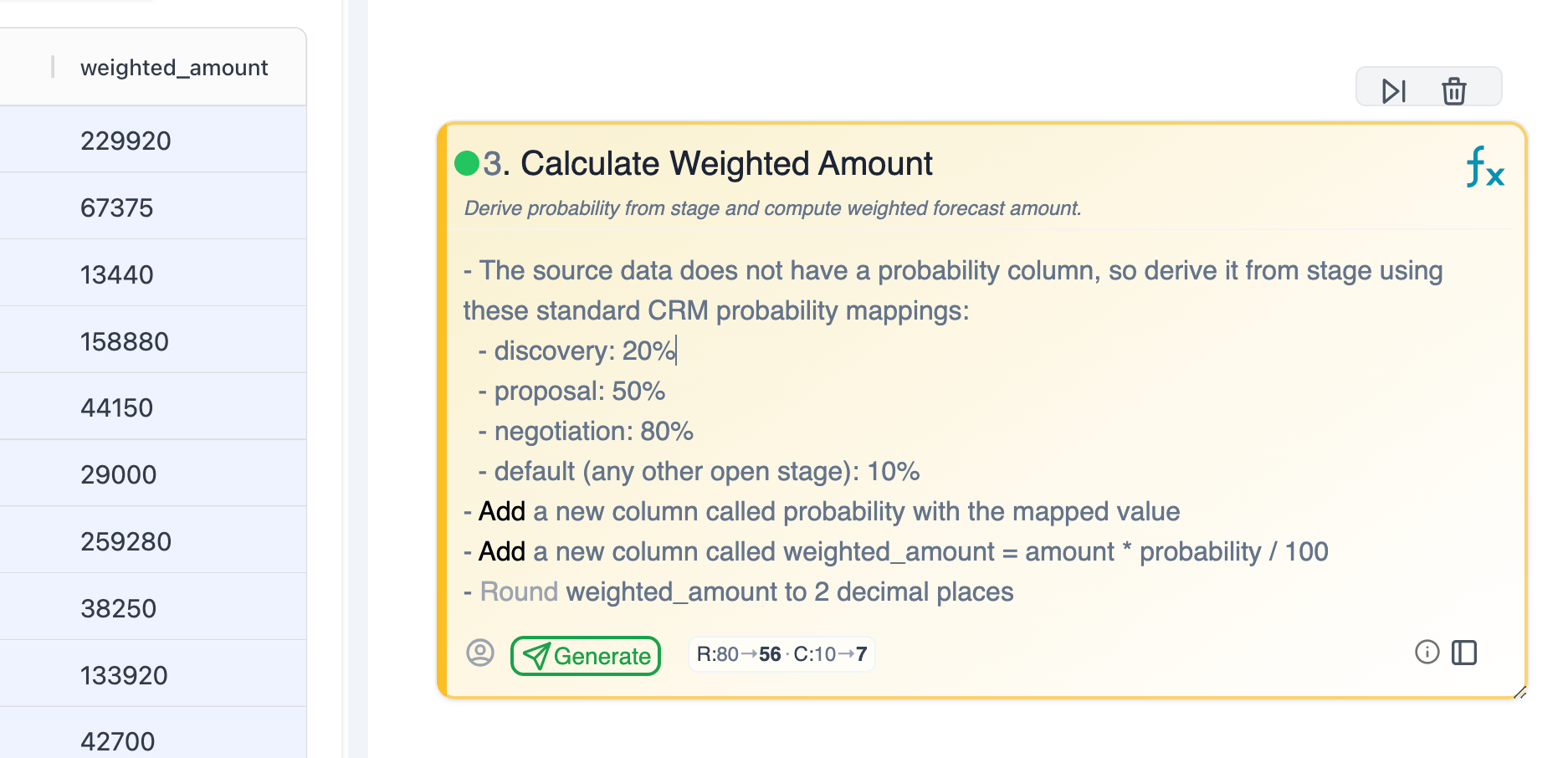
Every step can draw on your enterprise context — the definitions, policies, and playbooks your team already runs on — written once in plain English, like a stage-to-probability mapping or a revenue recognition rule. Preview exactly what a step produces before it touches real data.
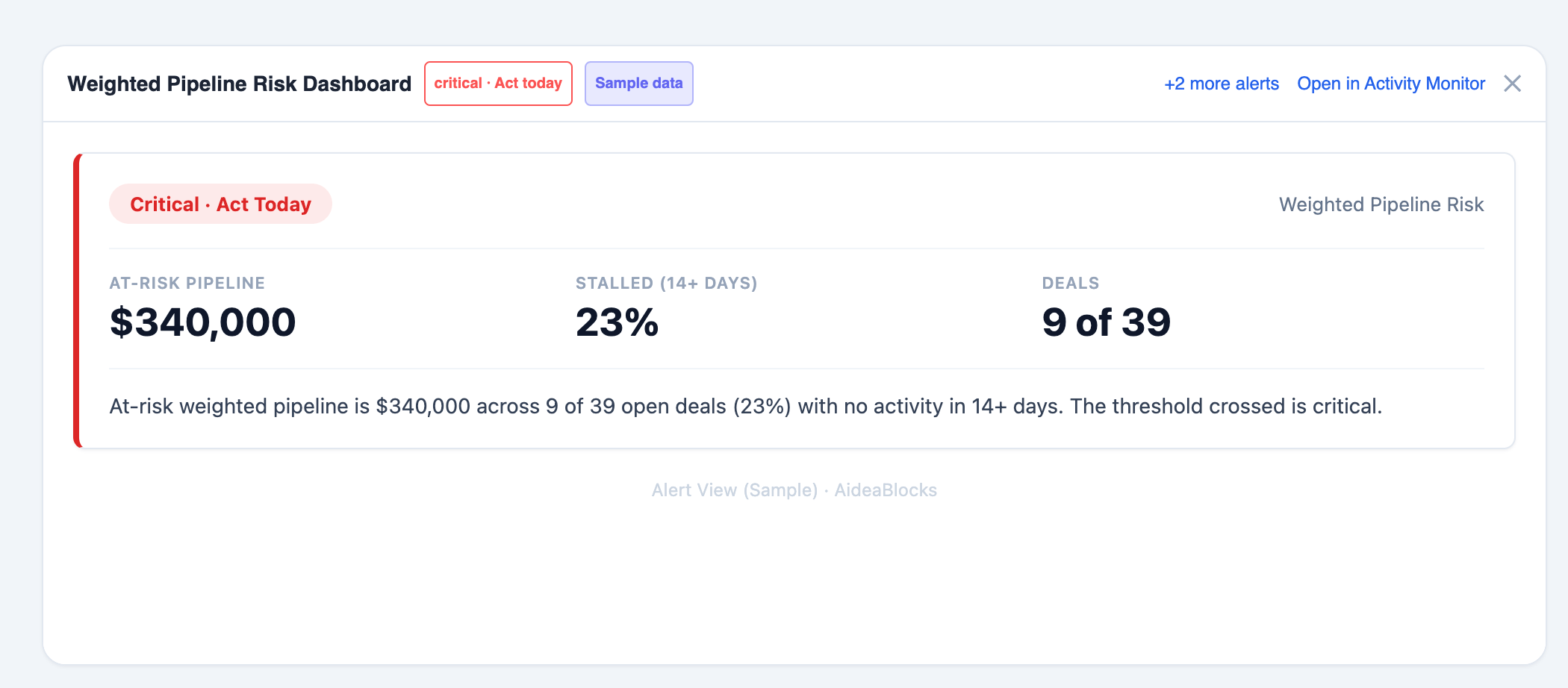
When a threshold like stalled pipeline or coverage gap gets crossed, AIdeaBlocks raises the alert — critical or warning — with a plain-English summary. Every alert traces back to the exact decision logic that produced it, so the answer to “why” is never just “trust me.”
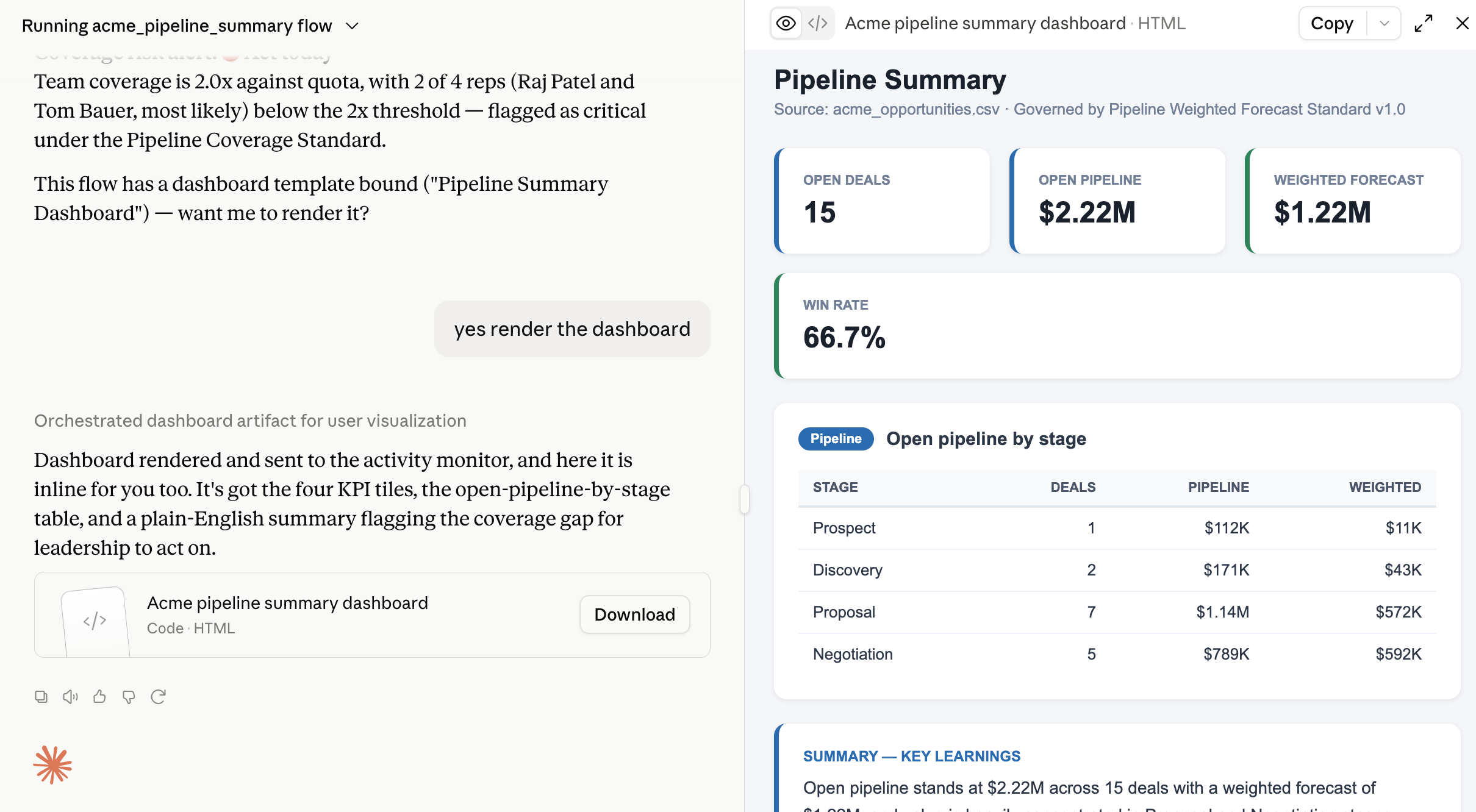
Once the logic is recorded, Claude (and other AI tools) doesn’t reason through your business rules from scratch — it calls the governed service through MCP. That’s what makes the answer repeatable and the token cost so much lower than re-deriving the same analysis in a fresh prompt every week.
Operationalizing Business Knowledge
AIdeaBlocks turns scattered business knowledge into governed execution. Instead of relying on tribal knowledge or inconsistent prompts, it automatically extracts business terms and policy definitions, schema definitions and other artifacts from documents, emails, and existing systems—then structures and connects them into a unified knowledge context layer. These terms and policies are not just stored—they are actively applied at runtime to every pipeline as step level intents, ensuring that data transformations, calculations, and outputs always follow approved business logic. The result is faster onboarding of institutional knowledge, consistent decision-making, and fully traceable, repeatable data workflows across your organization.
What lives inside the memory layer
Eight artifact types give AI the organizational context to act consistently, accurately, and in line with what your business has agreed is true.
Each artifact is governed, versioned, and traceable. Together they form the semantic layer that turns AI exploration into repeatable, trusted outcomes.
Example — RevOps
Artifacts in use
Revenue calculation policy
What it enables
Finance defines revenue once in AideaBlocks. Claude reads the policy via MCP and applies it to every pipeline query — so the number is the same whether RevOps, Finance, or the CEO runs the report.
AIdeaBlocks and Google Cloud Platform
Running natively on Google Cloud Platform (GCP), AIdeaBlocks seamlessly integrates with Google Cloud Storage and Google Drive, and BigQuery to unify structured data, documents, and external sources into a single, agentic ecosystem. From preparing data for analytics and machine learning to enforcing business policies and automating document-driven workflows, it provides a scalable foundation for modern data needs. AIdeaBlocks also connects to your CRM and other SaaS applications, and Excel and PDF documents to provide a unified view of your data assets.
AIdeaBlocks also leverages Google VertexAI for AI and agentic services. Users can also leverage OpenAI and Anthropic models.
AIdeaBlocks is also available on the Google marketplace where users can use their Google credits to subscribe to AIdeaBlocks.